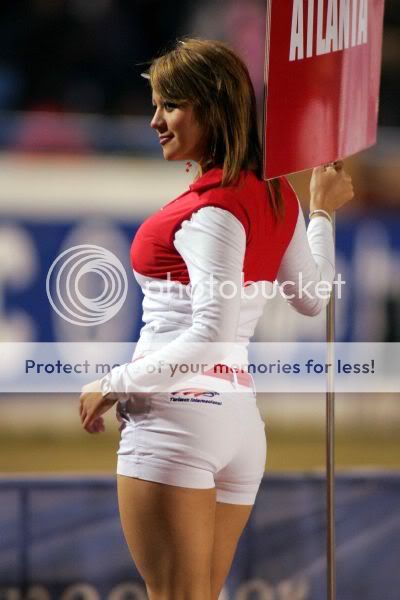
Soccer Babes – Mexican Primera Apertura 2009 Semi-Finals Cheerleaders / Porristas

Over the past five days the semi-finals of the Mexican Primera Apertura 2009 playoffs took place. Playing for a chance in the finals were Cruz Azul, Monterrey, Morelia and Toluca. Their respective cheerleaders were also out to support their teams and are the focus of this week’s Mexican Primera cheerleaders review. As usual, we’ve got a ton of them for your viewing pleasure again. Enjoy them while you can as there is only one round left in the Mexican playoffs.

Check this space every Monday for more of these chicas. If we run into more of them during the week, we’ll bring you some bonus coverage.

Mexican Apertura 2009 PorristasMexican Apertura 2009 PorristasMexican Apertura 2009 PorristasMexican Apertura 2009 Porristas

Mexican Apertura 2009 PorristasMexican Apertura 2009 PorristasMexican Apertura 2009 PorristasMexican Apertura 2009 Porristas

Mexican Apertura 2009 PorristasMexican Apertura 2009 PorristasMexican Apertura 2009 PorristasMexican Apertura 2009 Porristas

Mexican Apertura 2009 PorristasMexican Apertura 2009 PorristasMexican Apertura 2009 PorristasMexican Apertura 2009 Porristas

With Friday’s FIFA World Cup 2010 Draw completed and the tournament’s groups set, the pundits of soccer have started their analyses and predictions. So have scores of soccer fans around the world who promptly entered the search phrase “World Cup 2010 Simulator” into their search engines to little avail.

While there aren’t too many simulators for World Cup 2010 around yet, we’ve found a beauty at mediotiempo.com that let’s you simulate the entire tournament from the group phase to the final. To launch the simulator just click on Simulacion de la Fase Final (Final Stage Simulator in English) at the bottom of the page to launch the application. After that it’s easy to use regardless of what language you speak. Check it out at the link below.

FIFA World Cup 2010 Simulator at mediatiempo.com

Miss World Contestants Tour a World Cup 2010 Stadium

Miss World contestants pose for photographers at Ellis Park stadium in Johannesburg on November 20, 2008. (From left) Miss New Zealand Julia Kahurangi, Miss Egypt Sanaa Ismail Hamed, Miss Brazil Sila Almeida Tamara, Miss World Zilin Zhang, South African former football player Lukes Habeba, Miss South Africa Tansey Coetzee, Miss Italy Claudia Russo, Miss USA Mercia Lane Lindell and Miss Spain Patricia Yurena Rodriguez Alonjo. The contestants will assist in the Confederations Cup draw on November 22.

Draw ignites FIFA World Cup fever

The 32 teams participating at next year's FIFA World Cup™ finals discovered their fate this evening when the Final Draw for South Africa 2010 took place in Cape Town.

While South Africans learned that the host nation's Opening Match on 11 June would be played against Mexico at Soccer City, it was the Group D line-up which caused arguably the biggest stir. Germany, Australia, Serbia and Ghana will battle it out for two qualifying places for the Round of 16, meaning two nations with passionate support will depart the tournament early. There could be a high-profile casualty from Group G too, after Brazil, Korea DPR, Côte d'Ivoire, Portugal were drawn together.

An estimated global television audience of 200 million joined the 2,000 invited guests in the Draw Hall in watching the colourful and entertaining ceremony unfold. With African sporting stars such as athlete Haile Gebreselassie, rugby player John Smit, cricketer Makhaya Ntini, and footballers Matthew Booth and Simphiwe Dludlu assisting with the draw, along with England's David Beckham, it was always going to be an exhilarating occasion, but the undoubted centrepiece came when the eight groups were revealed.

An early highlight of the draw was the eye-catching encounter between England and USA, scheduled for 12 June, which evokes the Americans' famous 1-0 win over their transatlantic cousins at Brazil 1950. Argentina, Nigeria and Greece will get the chance to revive their group rivalry from 1994, while the heavyweight collision between Portugal and Brazil on 25 June also has the feel of a derby.

Group A: South Africa, Mexico, Uruguay, France
Group B: Argentina, Nigeria, Korea Republic, Greece
Group C: England, USA, Algeria, Slovenia
Group D: Germany, Australia, Serbia, Ghana,
Group E: Netherlands, Denmark, Japan, Cameroon
Group F: Italy, Paraguay, New Zealand, Slovakia
Group G: Brazil, Korea DPR, Côte d'Ivoire, Portugal
Group H: Spain, Switzerland, Honduras, Chile

A night to remember
With such an array of stars, the event dazzled from start to finish. After a welcome sequence from Lions Head, the mountain that provides Cape Town with such a dramatic backdrop, award-winning musician Johnny Clegg performed 'Scatterlings of Africa', a song made famous by the Academy Award-winning film Rain Main.

Fittingly, the first speech of the night came from the man without whom a FIFA World Cup in South Africa would never have been possible: the country's former president Nelson Mandela. The 91-year-old, speaking in a special video message, urged his nation to make the most of their opportunity as tournament hosts. "We must strive for excellence in our hosting of the World Cup, while at the same time ensuring the event leaves a lasting benefit to all our people," he said.

Next it was time for two special presidents to take to the stage. FIFA President Joseph S. Blatter and South African President Jacob Zuma showed their excitement at both the Final Draw and the 2010 FIFA World Cup itself in an entertaining dialogue lasting several minutes. Giancarlo Abete, President of the Italian Football Federation, then handed over the holders' FIFA World Cup Trophy to Mr Blatter, confirmation that sport's holy grail is in South Africa and ready to be contested next year.

Legendary Portugal striker Eusebio, born in neighbouring Mozambique, was introduced to the crowd before examples of the 'Win in Africa, With Africa' campaign were showcased before an expectant audience. Beninese singer-songwriter Angelique Kidjo duly took to the stage to perform her Grammy-nominated song 'Agolo'.

The first duty of the show's guest presenter, Academy Award-winning actress, Hollywood producer and proud South African Charlize Theron, was to show off the official 2010 Match Ball, adidas's Jabulani, a name meaning 'to celebrate' in Zulu. Soweto’s Gospel Choir continued the theme of happiness with a lively rendition of Pata Pata before the arrival of Draw Master and FIFA Secretary General, Jerome Valcke, signalled the moment of truth.

Some of the assembled coaches will have headed away feeling confident, others concerned by the task presented here, yet at least all now know what lies in store as they begin their planning and preparation for next year's showpiece.

Cities ready and waiting for the 2010 FIFA World Cup

Cities ready and waiting  for the 2010 FIFA World CupThe focus of the football world’s attention was squarely focused on Cape Town last night as the Final Draw for the 2010 FIFA World Cup™ mapped out the opening rounds of next year’s football showpiece.

In what Chief Executive Officer of the 2010 FIFA World Cup Organising Committee South Africa, Dr Danny Jordaan, described as ,”a great celebration of Africa”, the Final Draw was proof that South Africa is more than ready to put on a show like no other when the 32 teams arrive in the country.

For the Host Cities, last night was a significant moment as, for the first time, they had a clear idea of the teams and the fans they will be hosting next year.

It was soon evident that football fans in the smaller cities such as Polokwane, Rustenburg and Nelspruit will have the same opportunies to capture a glimpse of the football stars expected in South Africa next year.

Speaking after the Draw, Mayor of Nelspruit, Mr Lassy Chiwayo said, “We are excited on a number of fronts. With the 18 giraffes that tower above us at the Mbombela Stadium in Nelspruit, we too are ready to walk tall and deliver a great experience. Our people are amazing, warm and peaceful. “

Nelspruit will see Hondurus and Chile battle it out on 16 June 2010, with defending champions, Italy, playing New Zealand on 20 June 2010. All matches will be played in the newly built Mbombela stadium which boasts seating and structures resembling the wildlife of the surrounding areas.

Host city coordinator for Polokwane, Ndavhe Ramakuela, also promises to deliver a different World Cup experience for the teams and the thousands of fans. “We will welcome fans to a natural environment away from the noise and concrete of the city. We will offer something to everyone.”

Polokwane, in the northern province of Limpopo, offers fans that will be travelling to watch the France-Mexico or the Greece-Argentina game on 17 and 22 June respectively a variety of activities including game viewing or visits to the neighboring countries of Botswana and Mozambique.

The regal home to the Royal Bafokeng family, Rustenburg, will see an influx of fans too as they come to watch England against USA on Saturday 12 June 2010. Rustenburg can also expect an influx of African supporters as African favourites, Ghana, play against Australia on 19 June. Spokesperson for the Host City of Rustenburg said that fans will be well entertained and “can expect a royal treatment when they come to Rustenburg.”

Having built a stadium that was ready over a year ahead of the tournament, Nelson Mandela Bay will be entertaining fans from Chile, England, Portugal and Germany as they travel to the Eastern Cape for some superb on the field action.

With similar enthusiasm, says the Mayor of Port Elizabeth/Nelson Mandela Bay, Mr Zanoxolo Wayile, “We are more than prepared in terms of accommodation, transportation, safety and security, entertainment and of course the Nelson Mandela Bay stadium is one of the best facilities in the world. We are confident all ten teams will feel more than at home in a city named after the great man himself.”

With names such as France, Uruguay, Paraguay, England, Algeria, Portugal, Korea DPR, Cameroon, Netherlands as well as a Semi Final match to be hosted by the City of Cape Town, there is certainly a lot of excitement in the ‘Mother City’.

“Just looking at the draw, we were very happy with what we saw. There are some big names there and the tournament in Cape Town will certainly be a huge spectacle,” said Mayor of Cape Town, Dan Plato.

After the festivities on Long Street during the Final Draw celebrations – which saw an estimated 30,000 people take to the streets in celebration – Plato is confident that the visiting teams and fans will be treated to a festival atmosphere throughout the World Cup period.

“As a city we are very happy to host these teams in our stadium and our city. You can see from the vibe last Sunday when we turned on the festive lights in Adderley street and 120,000 people turned up to the party in Long Street last night to celebrate the Final Draw – there is a great vibe in this city and we have shown the world that we are ready for 2010.”

But the eyes of the world will be on Soccer City in Johannesburg on the day the tournament kicks off between host country South Africa and Mexico on 11 June 2010. As the gateway city to South Africa, Johannesburg has two stadiums and is the most central place to accommodate the fans with five of the ten stadiums within four hours driving distance.

Says Christa Venter of Joahnnesburg City, “The opening ceremony is going to be great – we look forward the vibe and seeing the Mexican wave in tandem with the vuvuzela.” Johannesburg will see most of the greats at some stage between Soccer City and Ellis Park stadiums, including Spain, Argentina, Brazil, Germany and Italy.

Capello's doing a great job

Bryan Robson wants Fabio Capello to continue to ride his luck during his tenure at the England reins. The Italian has steered the side to the brink of the 2010 FIFA World Cup South Africa™.

The former England captain is delighted at the progress being made and hopes key players stay fit. "Where Capello has been quite fortunate is that he's nearly always had the best players available," said Robson.

When our top players are not available we do not have that next best player to replace them. Ferdinand, Terry, Gerrard and Rooney are really important.
Former England midfielder Bryan Robson

"I feel as though that is where England have fallen down over the last ten years. When our top players are injured and not available we do not have that next generation, that next best player, to come in and replace them.

"That's why people like (Rio) Ferdinand, (John) Terry, (Steven) Gerrard and (Wayne) Rooney are really important to the England team. You do not want them injured for important games."

Robson also believes the players are growing in stature under the Capello. "He is doing a great job - you only have to look at the performances and results, " he said. "All you can do is the job that is in front of you.

"Fabio has done that well and the England boys are very confident. That's great because after the disappointment of not qualifying for the last European Championships it is really important to qualify for the World Cup."

Mike Summerbee, who won eight caps for his country, is also optimistic about the future under Capello. "By the time the World Cup comes around he will have a top side and England will be a very strong force," said the former Manchester City winger.

His influence in the side is fantastic. By the time the World Cup comes around England will be a very strong force.
Former England winger Mike Summerbee on Fabio Capello

"His influence in the side is fantastic and don't forget he was a great player as well. He has a good squad of people behind him and that is important.

"Fabio has brought some discipline to the team. People know what they are doing. No matter who you are, you can be left out. He has a squad that respects him and that situation leads to a successful side.

Asus EEE PC netbook for free, wanna get big chance ?

Revive Your Life site currently hold very interesting contest. Because the prize is laptop. Yes, for the winner, RYL will give Asus Eee
PC Netbook with Intel Celeron Processor. So interesting...!!!

What makes this contest more interesting is, to participate is easy. You required to subscribed to RYL and then your participated,
Wanna get bigger chance to win? Then you can do blog post, commenting, etc....

The detail are here :
http://reviveyourlife.com/uncategorized/ryl-is-giving-away-a-free-asus-netbook

South Afica Worldcup 2010 statistic

Statistics

Africa

TeamGoals ForGoals For AverageMatches Played
Burkina Faso Burkina Faso212.39
Côte d'Ivoire Côte d'Ivoire202.29
Mali Mali171.99
Ghana Ghana161.89

North, Central America and Caribbean

TeamGoals For
Goal For Average
Matches Played
El Salvador El Salvador362.415
Costa Rica Costa Rica342.613
USA USA332.513
Mexico Mexico241.813

South America

TeamGFGFAMP
Brazil Brazil251.814
Chile Chile231.614
Uruguay Uruguay231.614
Paraguay Paraguay201.414

Asia

TeamGFGFAMP
Uzbekistan Uzbekistan332.116
Japan Japan231.614
Syria Syria232.310
Korea Republic Korea Republic221.614

Oceania

TeamGFGFAMP
Fiji Fiji363.012
Vanuatu Vanuatu302.512
Solomon Islands Solomon Islands233.86
New Caledonia New Caledonia221.812

Europe

TeamGFGFAMP
England England263.77
Germany Germany183.06
Bosnia-Herzegovina Bosnia-Herzegovina183.06
Poland Poland183.06

Wellington to host play-off

Wellington's Westpac Stadium has been selected as the host venue for New Zealand's World Cup play-off against Saudi Arabia or Bahrain, announced New Zealand Football (NZF).

North Harbour Stadium and Waikato Stadium also tendered bids to stage the 14 Nov match but Wellington won out because of its bigger capacity.

"With a match of this magnitude we need to give ourselves the best possible chance of qualifying," NZF chief executive Michael Glading said in a statement. "If players feel more comfortable in one venue and we can get an extra 8000 fans playing their part, that could just be the edge needed to realise the dream of reaching the World Cup again."

Saudi Arabia and Bahrain play each other home and away in September with the winner to host New Zealand on 10 Oct before the return leg in Wellington. New Zealand have qualified for the FIFA World Cup™ once, in 1982, but advanced to the play-offs this time after winning the Oceania qualifying division. "This fixture is easily the most important football match ever played in New Zealand," Glading said.

Soccer Stars In South Africa

It is one of the many tragedies of the apartheid era in South Africa that footballers from the country were denied a chance to perform on the international stage.

Generations of stars never got the opportunity to test their mettle in competitions like the FIFA World Cup™ and the CAF Africa Cup of Nations because of the policy of separation practiced by the white minority regime.

South Africa did not compete in a FIFA World Cup or a Cup of Nations qualifying campaign until 1992, which means that for some 60 years their footballers stood on the sidelines and watched while the rest of the world got on with the business of competition.

Yet there were South Africans who did manage to taste international football, but had to represent other countries to compete at that level.

Hodgson the hero
The first real superstar of South African football was Gordon Hodgson, who played in the country's first-ever international against Northern Ireland in Belfast in 1924.

He later went on to play for Liverpool and England and his record of 17 hat-tricks for Liverpool is yet to be broken.

After World War Two, a flurry of South African footballers left to play in England, almost all of them white, who were members of the racially-segregated national side.

Bill Perry played for England and scored the winning goal in the famous 'Matthews' FA Cup final of 1953 when Blackpool came from behind to beat Bolton Wanderers 4-3.

John Hewie was the first South African to play in a FIFA World Cup. Thanks to his ancestry, he was picked to play for Scotland in Sweden in 1958.

The first black footballers to leave South Africa were Darius Dhlomo and Steve Mokone, who made a major impression at Heracles Almelo in the Netherlands. They were major heroes for the black population, who because of apartheid had few role models in their society.

Later David Julius left South Africa because of apartheid and played at Sporting Lisbon. As 'David Juliao', he was capped by Portugal.

South African Albert Johanneson was the first black player to play in a FA Cup final for Leeds United in 1965.

Colin Viljoen and Brian Stein, whose father was an anti-apartheid activist and had to flee the regime, both played later for England at a time when there was no South African national side to represent.

Roy Wegerle, who competed for the likes of Chelsea, QPR and Luton Town in England's top flight, became an American citizen through his wife and competed at the 1994 and 1998 FIFA World Cup finals. His decision to take up the opportunity to play for the USA came just before South Africa's re-admission into international football.

The forgotten footballers
Names like Pule 'Ace' Ntsoelengoe, Kaizer Motaung and Jomo Sono are legendary in South Africa, but their impact on the international scene is negligible.

Had they, however, been exposed to international audiences and competition, who knows how different their futures and profiles might have been.

Ntsoelengoe, who died last year at the age of 50, is generally regarded as the best ever South African footballer. His career alternated between the colours of Kaizer Chiefs and clubs in the North American Soccer League. Two years ago he was inducted into the US Soccer Hall of Fame.

In the late 1960s and throughout the 70s, the NASL in the USA and Canada was only the outlet for top South African talent and Ntsoelengoe was one of many who crossed the Atlantic Ocean to play in the league.

Sono was an understudy to Pele for New York Cosmos and later helped Toronto Blizzard to win the NASL title.

Motaung was the first South African to go the USA and was named Rookie of the Year in 1968. He later came home and started a new club called Kaizer Chiefs, today the country's best supported team.

Since the end of apartheid, South African footballers have had the same opportunities as the rest of the world and players like Lucas Radebe, Benni McCarthy and Steven Pienaar have been able to compete at the highest level.

Indeed, McCarthy is the only South African international to have won a UEFA Champions League medal, with FC Porto in 2004.

2010 FIFA World Cup: Latest Ticketing figures

It is a very special day tomorrow, when it will be exactly one year to kick-off of the 2010 FIFA World Cup™ South Africa, the very first on African soil. The second ticketing phase on a first come, first serve basis will continue until 16 November.

As of today (with four out of 32 teams qualified, in addition to the hosts South Africa) there have been a total of 630,021 tickets in 188 different countries/territories sold. Nearly half of those total orders have been submitted by South Africans (301,601). Outside of South Africa, supporters from the USA have purchased the largest number of tickets (73,441), followed by the United Kingdom (42,907), Germany (30,880) and Australia (15,038). Reigning champions Italy have so far received 6,063 ticket orders, Brazil 5,777 and from France 5,106 tickets have been so far sold.

FIFA Confederations Cup: Ticketing centres will be open until last minute
The final countdown is on: With only four days to the first match of the FIFA Confederations Cup 2009 on 14 June - with the home team South Africa facing Iraq at Ellis Park - there have been already more than 70 % (this corresponds to a figure of 438,000) sold of the total of tickets available. To cater for the expected last-minute surge of demand, tickets can be purchased (even on match days) at:

  • Main Ticketing Centre at Sandton Isle, Corner of Rivonia Road and Linden Street, Sandown/Johannesburg;
  • Mangaung/Bloemfontein Venue Ticketing Centre - Lochlogan Waterfront Mall, Corner of Charles Street and 1st Avenue;
  • Rustenburg Venue Ticketing Centre - Waterfall Mall, 1 Augrabies Avenue;
  • Tshwane/Pretoria Venue Ticketing Centre - Brooklyn Mall, Corner of Middel and Fehrsen Street, New Muckleneuk;

The ticket centres will be open from 9am-6pm, seven days a week.

To further assist football fans, a Ticketing Call Centre has been established and fans can call 0832010010 to book their seat at the FIFA Confederations Cup. Please be aware, that there will be no ticket sales at the four stadiums.

Vuvuzela big plastic trumpet : SA football's beautiful noise

FIFA WORLDcup 2010What's plastic, a metre long, brightly coloured and sounds like an elephant? It's the vuvuzela, the noise-making trumpet of South African football fans, and it's come to symbolise the sport in the country.

It's an instrument, but not always a musical one. Describing the atmosphere in a stadium packed with thousands of fans blowing their vuvuzelas is difficult. Up close it's an elephant, sure, but en masse the sound is more like a massive swarm of very angry bees.

And when there's action near the goal mouth, those bees go really crazy.

To get that sound out requires lip flexibility and lung strength - in short, a fair amount of technique. So be sure to get in some practice before attending a South African football match, or you the sound you produce may cause some amusement in the seats around you!

Vuvuzela supplier Boogieblast offers this advice: "Put your lips inside the mouthpiece and almost make a 'farting' sound. Relax your cheeks and let your lips vibrate inside the mouthpiece. As soon as you get that trumpeting sound, blow harder until you reach a ridiculously loud 'boogying blast'.

Descendant of the kudu horn?

The ancestor of the vuvuzela is said to be the kudu horn - ixilongo in isiXhosa, mhalamhala in Tshivenda - blown to summon African villagers to meetings. Later versions were made of tin.

The trumpet became so popular at football matches in the late 1990s that a company, Masincedane Sport, was formed in 2001 to mass-produce it. Made of plastic, they come in a variety of colours - black or white for fans of Orlando Pirates, yellow for Kaizer Chiefs, and so on - with little drawings on the side warning against blowing in the ear!

There's uncertainty on the origin of the word "vuvuzela". Some say it comes from the isiZulu for - wait for it - "making noise". Others say it's from township slang related to the word "shower", because it "showers people with music" - or, more prosaically, looks a little like a shower head.

The announcement, on 15 May 2004, that South Africa would host the 2010 Fifa World Cup gave the vuvuzela a huge boost, to say the least - some 20 000 were sold on the day by enterprising street vendors.

It's a noisy thing, so there's no surprise some don't like it. Journalist Jon Qwelane once quipped that he had taken to watching football matches at home - with the volume turned low - because of what he described as "an instrument of hell".

Viva the vuvuzela orchestra!

Cape Town-based music educator Pedro Espi-Sanchis has a different view, however: to him the vuvuzela is a rousing instrument that can, when tuned correctly, play in an orchestra as easily as a flute, violin or cello.

Espi-Sanchis says the vuvuzela is a "proudly South African instrument" with roots deep in local traditional music. He was introduced to it over 30 years ago by renowned South African ethnomusicologist Andrew Tracey.

A fan of football himself, Espi-Sanchis came up with the idea of a vuvuzela orchestra after realising that crowds at a match could coordinate their trumpeting to make music. "I heard the vuvuzelas at soccer games and the sound was not musical at all," he says. "Vuvuzelas need to play rhythms together to really show their power."

In 2006 Espi-Sanchis and Thandi Swartbooi, head of the South African traditional music group Woman Unite, launched a vuvuzela orchestra as part of the Cape Town-based uMoya Music organisation.

Made up of a core group of seven people, with Espi-Sanchis as conductor and soloist on the lekgodilo flute and six musicians each playing a vuvuzela, the orchestra made its first public appearance at the Johannesburg Carnival in December 2006.

Their first performance at a soccer match was at the Nelson Mandela Challenge match at Ellis Park stadium in November 2007, when Bafana Bafana took on the USA.

Espi-Sanchis found an excellent local football fan base to accompany the vuvuzela orchestra. Supporters of Bloemfontein Celtic football club, based in the Free State, "form one of the best fan bases in South African soccer," he says. "In November [2007], we taught 60 of these fans to play seven songs in just five days.

"Each of our six musicians was responsible for 10 fans, and they taught them to play their parts. Celtic fans also taught us some of their wonderful songs, and together we supported Bafana Bafana at the Mandela Challenge by singing and dancing with the vuvuzela orchestra."

"Now we want to bring up a fan base to support our national team," says Espi-Sanchis. "The vuvuzela music can be learnt very quickly ... we want to use the Celtic supporters as models for a national fan base."

Whether or not Espi-Sanchis' ambitions are realised, vuvezalas are bound to play an integral part in South Africa's 2010 celebrations, and World Cup visitors are sure to go home with a vuvuzela or two tucked in their luggage - and a little ringing in their ears ...

SAinfo reporter and MediaClubSouthAfrica.com

Asian Player on FIFA World Cup Africa 2010

2010 fifa world cup south africaAfter Korea Republic, Japan and Australia booked their places at the 2010 FIFA World Cup South Africa™ at the weekend, the results on 10 June mean competition for the remaining automatic qualifying spot and two third-place berths should go down to the wire.

Needing a point away against Australia to seal third place in Group A, Bahrain failed to achieve their goal, slumping to a 2-0 defeat. This result leaves the Gulf side needing a draw from their decisive final match at home against Uzbekistan in a week's time.

Meanwhile, there will be no such opportunities for Qatar, who despite bravely holding hosts Japan to a 1-1 draw in their final game, were eliminated after taking only six points from eight qualifiers. Following the lead of the United Arab Emirates, the Qataris became the second side to bow out in the Asian Zone's final qualifying round.

Over Group B, Saudi Arabia's goalless draw in Korea Republic kept them level on 11 points with Korea DPR, though the latter are still ahead on goal difference. Iran, for their part, notched their first win in four games with a narrow home defeat of UAE to keep their faint hopes of reaching South Africa 2010 alive.

Matchday 9 results:
10 June 2009

Group A: Japan 1-1 Qatar; Australia 2-0 Bahrain
Group B: Iran 1-0 United Arab Emirates; Korea Republic 0-0 Saudi Arabia

The big game
Iran 1-0 United Arab Emirates
Ali Karimi (53')

With Iran coach Afshin Ghotbi and his charges desperate to take all three points, Ali Karimi's solitary strike was as crucial as it was spectacular. After a disappointing first half, during which the home side struggled to pierce the visitors' rearguard, eight minutes into the second period former Bayern Munich midfielder Karimi picked up an Andranik Teymourian pass outside area before outwitting a slew of defenders and sliding a left-footed shot past UAE goalkeeper Majed Naser. The win puts the Iranians hot on the heels of Group B rivals Saudi Arabia and Korea DPR, while victory for Ghotbi's side away to Korea Republic in their final encounter would ensure they finish no lower than third.

The surprise
Japan 1-1 Qatar
Ahmed Ali Albinali (2' OG), Ali Yahya (53' PEN)

Qatar went into their final game against Japan needing all three points and plenty of goals to give them a glimmer of hope of a third-place berth in Group A. Coach Bruno Metsu's charges were hit by an early own goal, Ahmed Ali Albinali turning Atsuto Uchida's cross into his own net after only two minutes, but battled back for a spirited draw. It was Ali Yahya who grabbed the equaliser from the penalty spot eight minutes into the second half, but the single point attained meant they now have no chance of overtaking third-placed Bahrain.

The other games
Australia 2-0 Bahrain
Mile Sterjovski (55'), David Carney (88')

With Australia already qualified and Bahrain needing just a point, the game at Sydney began slowly and with few clear-cut chances. The visitors had looked the better side after the interval only for the Socceroos to take the lead when Mile Sterjovski capitalised on a defensive error. And after Bahrain had squandered two decent chances to get back on level terms, Aussie midfielder David Carney put the game beyond any doubt with two minutes remaining by steering Jason Culina's bicycle kick into the back of the net.

Korea Republic 0-0 Saudi Arabia
Saudi Arabia coach Jose Peseiro must be a relieved man after seeing his side survive a second-half onslaught from Korea Republic to pick up a point at Seoul. The visitors had the lion's share of possession in the first half but the tables were well and truly turned after the break. Despite going down to ten men late on after Ahmeed Ateef's dismissal for a second yellow card, the Saudis very nearly snatched victory with a last-gasp header from Naif Hazazi which flew just over. The draw means the Saudis must win their final game against Korea DPR in Riyadh, with their east Asian opponents needing just a point to go through.

The player
Iran's gifted 30-year-old Karimi proved that when he finds his best form, so do Iran. Author of an inspirational display in his previous outing for Team Melli against Korea DPR, he further cemented his place in coach Ghotbi's heart with a stunning winner against UAE.

The stat
200
- Karimi's decisive strike was Iran's 200th in 36 years of FIFA World Cup qualifying action. The goal also made Iran the first Asian Zone nation to hit the double-century mark.

What they said
"Although they had already qualified for the World Cup, South Korea showed their excellent mentality and made life hard for us. I hope the two teams will meet again in South Africa," Saudi Arabia coach Jose Peseiro.

Will England on FIFA World Cup South Africa

Wayne Rooney and Jermain Defoe both scored twice as England gave 58,000 fans, who refused to be beaten by a London travel nightmare, ample reward for their defiance with their biggest win in a competitive game since 1999.

After hitting their part-time opponents for six at Wembley, just as they did against Luxembourg a decade ago, the Three Lions know a win against Croatia on 9 September will seal a place at next year's 201 FIFA World Cup South Africa™ with two games to spare.

And if England make it, Fabio Capello will want Rooney in the same form as he has showed this season, his latest brace enough for him to streak clear in the FIFA World Cup qualifying sharp-shooters table with eight goals.

Frank Lampard's effort was sandwiched in between and half-time substitute Defoe scored twice in as many minutes before Peter Crouch netted his 14th goal in 16 international starts to take England's overall tally to 26.

While Defoe could be particularly pleased with his cameo, Rooney was the name on supporters lips as they began a journey home somewhat more testing than anything Andorra provided for their team.

In a bid to get the most out of Rooney, Capello came up with a rather simplistic hint for the Manchester United striker, get in front of the goal While it would be slightly silly to offer Sir Alex Ferguson any advice, given the wider role he was given at Old Trafford, Capello's way is better.

Certainly the statistics, eight goals in seven qualifiers compared to 12 in an entire Premier League season, seem to bear that theory out. And, with possibly both Carlos Tevez and Cristiano Ronaldo heading out of the Red Devils camp this summer, Ferguson might have to rejig his forward line anyway.

It must have been particularly gratifying for the Italian to see Rooney drill home a couple of close-range efforts before the interval as England disposed of their part-time opponents with the minimum of fuss.

Indeed, there seems to be a touch of genius about Capello's entire management strategy given England are now consistently delivering performances of such assurity, a bad 35 minutes in Kazakhstan apart, it is difficult to believe they failed to score in the first-half of their last meeting with Andorra in September. There was never any chance of such a stalemate this time around.

Quite conceivably, Rooney could have been celebrating his hat-trick when Glen Johnson picked him out with a deep cross that, unmarked, the forward had little trouble finding the net with.

As they were only at the four minute stage, it just about said it all about the one-sided nature of what passed for a contest. A smart turn onto Steven Gerrard's pass created Rooney's first opening, a deft chip that Koldo Alvarez did well to touch over the bar. The second was a more instinctive header that crashed back off the crossbar after Alvarez had denied Theo Walcott.

Peter Crouch and Gerrard might have scored in a little flurry around the ten minute mark but England were made to wait almost until the half hour before finding the net again, Frank Lampard powerfully drilling home Walcott's cutback.

Johnson was the provider for a momentous goal for Rooney, which allowed him to draw level with Sir Geoff Hurst as England's 12th highest scorer on 24. For the record, Rooney also equalled Gary Lineker's record for the most goals in a single international season, ten.

As Rooney notoriously hates missing any football, he might not have taken his interval substitution too well, particularly as the opposition suggested a first England hat-trick was on the cards.

However, in replacing both Rooney and Gerrard with Defoe and Ashley Young, Capello was able to have a decent look at a couple of the fringe players who hope to be on the flight to South Africa in 12 months' time.

Defoe took his chance well scoring twice, Johnson setting up the first to take his number of assists to three, in a similar manner to Rooney before Crouch tapped home after a woeful mistake from Alvarez.

Capello will realise his team must overcome far stiffer tests if they are to emulate the 1966 heroes who got long overdue medals to mark their achievement. But the signs are undeniably positive. And, one senses, in his own understated way, the Italian knows it.

Sarah Brandner Euro 2008 favourites capable

Sarah Brandner Bastian Schweinsteigernineteen-year-old Sarah Brandner, partner of German midfielder Bastian Schweinsteiger. The fugly Bayern Munich star has had five girlfriends in the past year-and-a-half, but insists that he has found happiness with his latest beau: “she has played a big part in my performances lately,” he insists.

Sarah BrandnerBastian Schweinsteiger

Sarah works for Place Models in Hamburg and first met Schweini at a social event in Munich, where she was accompanied by heavyweight boxer Vladimir Klitschko. The pair met again in Ibiza, and it’s been a blond-haired match made in heaven ever since. “Wir sind sehr verliebt” (”we are so in love”) was the key message from a slushy interview she gave to German newspaper Bild recently.

See Sarah Brandner style here :